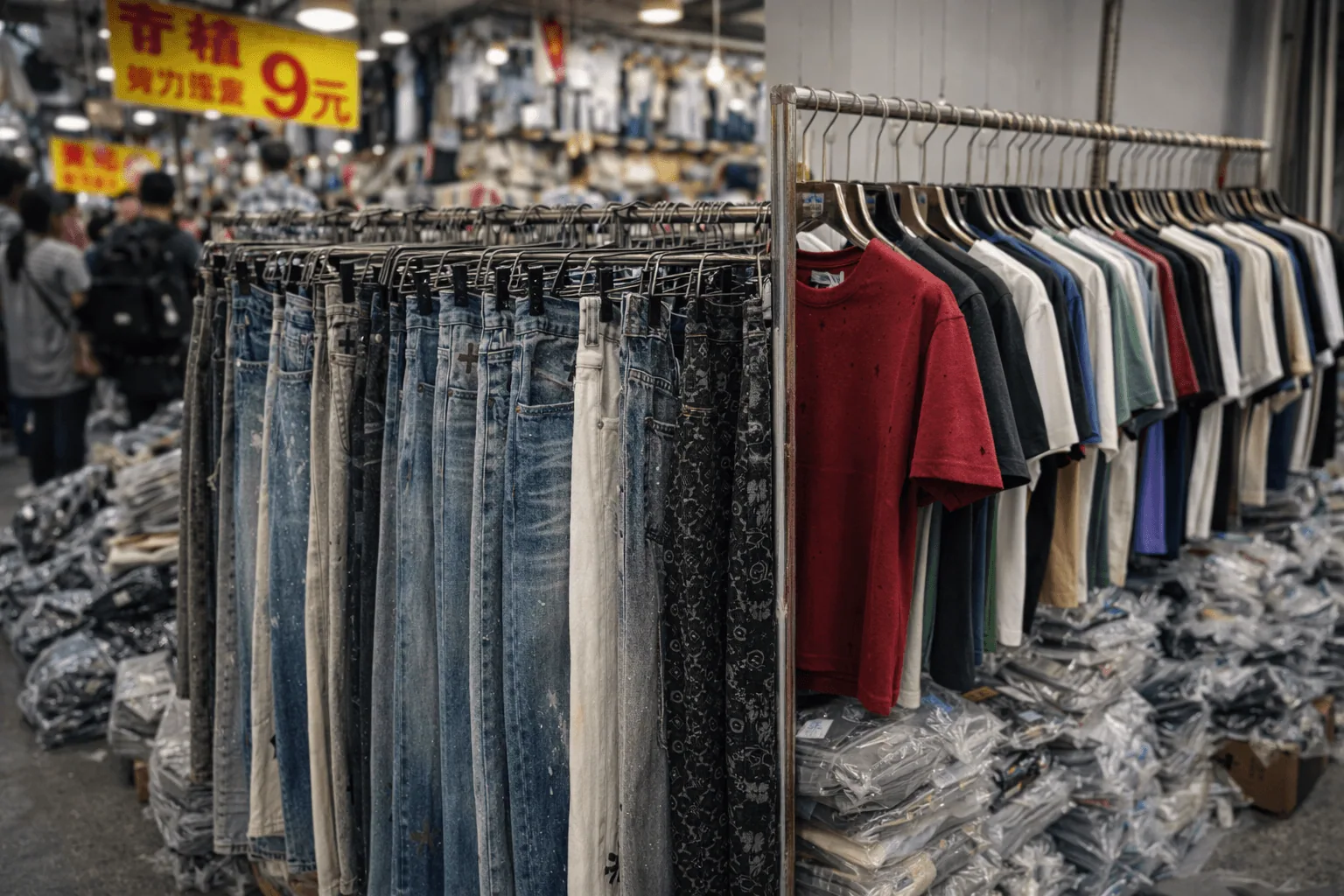
Recently, there has been a significant increase in requests from brands that do not want to launch production, but instead consider a simpler route — purchasing ready-made clothing in China, relabeling it, packaging it, and selling it under their own brand.
At first glance, this appears to be a fast and convenient approach: no need to develop a product, no need to wait for production, and no need to dive deeply into the processes.
However, in practice, this approach has a number of limitations that are important to understand before getting started.
"Buying ready-made clothing is not an alternative to manufacturing. It is a separate tool with its own limitations, risks, and objectives."
Price: non-obvious logic
It often seems that ready-made products in China should be cheaper than manufacturing. However, this is not always the case.
In most cases, the price of ready-made products already includes not only production, but also storage, resale, and intermediary margins. Therefore, under normal conditions, manufacturing—especially at scale—will indeed be more cost-effective.
However, there is an important exception that regularly occurs in practice. The market often sees products sold below their production cost. This may be due to clearance of leftovers, unclaimed or rejected batches, or simply warehouse liquidation.
In such cases, you may see a situation where an item that costs around 50 yuan to produce is sold individually for 30. But the key factor here is volume.
"Cheap products in China are almost always limited to leftover stock. This is not manufacturing — it is clearance."
You may be able to purchase 10, 20, or sometimes 50 units, but you will not be able to build a consistent batch for a brand. And if the goal is not just to buy, but to develop a product line, this approach quickly reaches its limits.
Repeatability: the key limitation
Even if you find a successful model, it does not mean you will be able to purchase it again. In manufacturing, you work with a model. With ready-made goods, you deal with a specific batch.
This batch may be leftover stock, a test run for another brand, or products that were never collected by the original client.
This makes stable scaling impossible. You cannot replicate a successful item, build a predictable assortment, or manage sales over time.
Materials: hidden risk
Very often, a model visually fits the task perfectly. The style, color, and fit all match. However, the material may not meet expectations. This is one of the most common gaps between what you see and what you actually get.
And this cannot be changed. Even if the model fits, the material may not meet requirements in terms of quality, composition, or consistency.
Sourcing: more complex than it seems
A separate challenge is the sourcing process itself. Clients often come with references—photos, selections, examples from European or Russian markets.
However, the Chinese market operates on its own logic. What is relevant in one region may simply not exist in China in ready-made form.
As a result, sourcing becomes a separate task with no guaranteed outcome. It requires time and resources, and may still yield no suitable results—especially when dealing with design-driven items rather than basics.
When it works
Despite its limitations, buying ready-made clothing remains a viable tool. It is effective in situations where time is the key factor. When the season has already started and there is no product available, production cannot meet the deadline. In such cases, purchasing basic models becomes a logical solution.
"Ready-made clothing is a tool for speed, not a tool for building a brand."
This approach works for simple products without complex construction or requirements for uniqueness. It allows you to quickly obtain goods, package them, and bring them to market.
What stock means in practice
It is important to understand what exactly you are buying. Stock is not a guarantee of quality. It may consist of leftover batches, products made for another market, mismatched sizing, or rejected items.
"Sellers do not explain the origin of stock. They simply sell it."
This means that quality must be checked separately. The fit may not match the target market, especially when dealing with differences between Asian and European sizing. And if an issue arises, it cannot be corrected.
Limitations on modifications
In manufacturing, you control the product. You can change the fabric, adjust the fit, refine the construction, and fix issues. This is the key difference that defines the boundary between the two approaches.
Lack of exclusivity: the model is easily replicated
Another critically important point is the lack of any product protection. If you find a successful model, purchase it, repackage it, and start selling, it does not mean you are the only one who can do so.
The exact same model can be found by any other market participant.
"Ready-made goods do not belong to you. You are simply one of those who bought them."
This is especially evident on marketplaces and in the mass segment. Once a model starts selling, it becomes visible, and other sellers begin searching for similar products.
In practice, this happens quickly: someone finds the same item, buys it, adds their own label, and goes to market.
This is where the key difference from manufacturing becomes clear. Replicating a ready-made model is simple—you just need to find it.
Replicating production, however, involves working with patterns, construction, materials, and factories. It is more complex, takes more time, and requires resources. This is what creates a barrier to copying.
Conclusion
Buying ready-made clothing in China is a practical tool, but with a limited scope of application. It provides speed and allows for a quick launch and immediate problem-solving.
However, it does not provide control, repeatability, or the ability to build a product over time.
If the goal is to build a brand, manage quality, and scale, this approach does not work without manufacturing. If the goal is to quickly obtain goods here and now, ready-made products can be a solution.
It is important to understand where convenience ends and limitations begin.
Related articles
Recycled Materials in Apparel: A Trend or the New Reality?
In 2026, recycled materials have definitively moved beyond being just a marketing tool for major brands.

How to Launch Clothing Production in China
China has long been the center of global clothing manufacturing. Many companies aim to launch production there efficiently, but they often face unexpected challenges.
MOQ for clothing manufacturing in China
For brands planning clothing production in China, this is one of the key parameters.