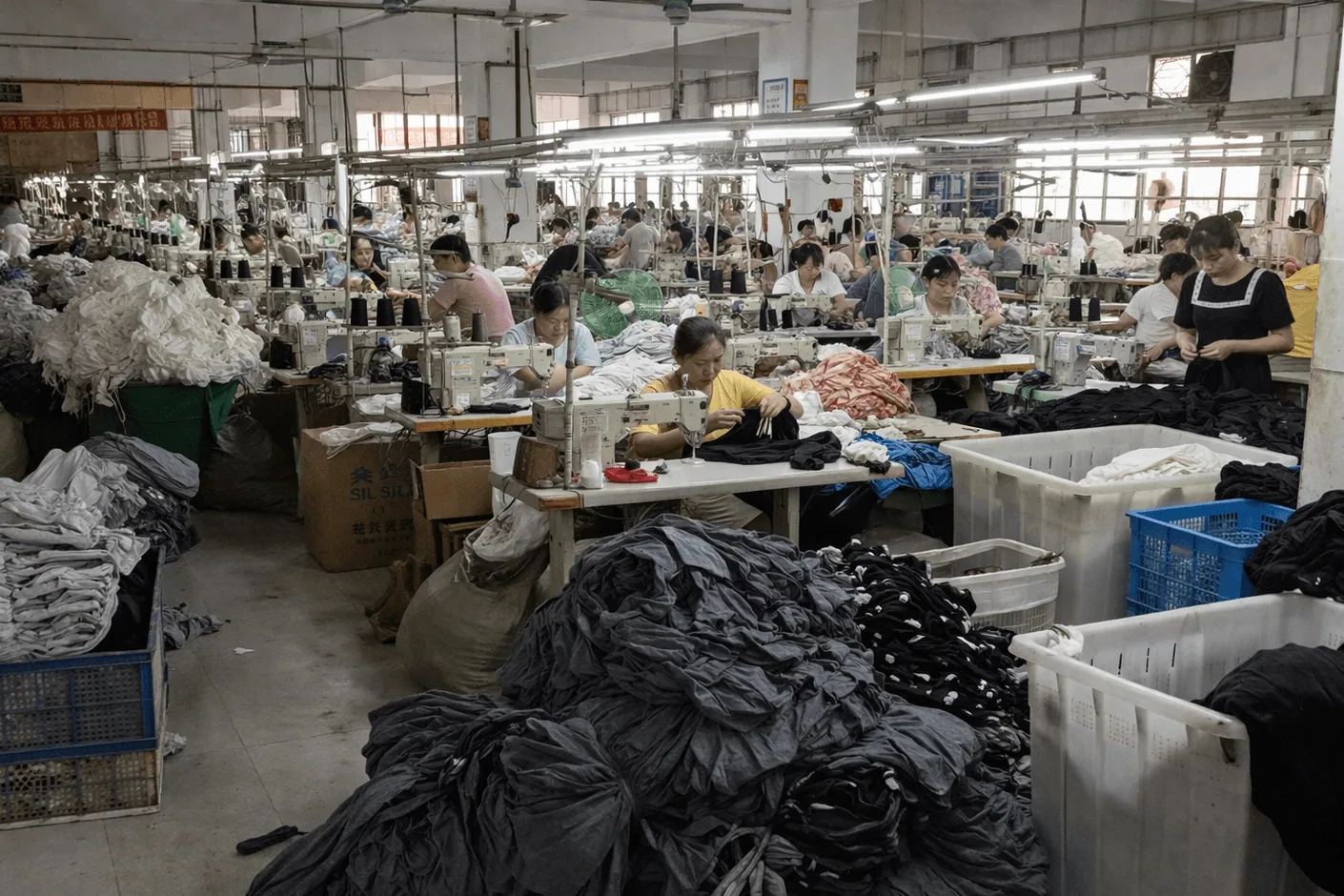
It is important to understand: during the first visit, almost any factory will say that they can do everything, handle anything, and are ready to work. This is almost always the case.
"At the beginning, a factory shows the maximum of its capabilities. The real check starts in the details."
Checking a Factory Is a System, Not a Visit
Checking a factory is not just a trip or a visual inspection. It is a systematic process of risk assessment. If you approach it formally, you will get a formal result. If you approach it systematically, you will understand who you are actually working with.
The foundation of any factory check is a checklist. It should include:
- production processes
- equipment
- workload
- product type
- working conditions
- financial and contractual parameters
A check without a checklist is a subjective impression, not a management decision.
Trading Companies and “Non-Owned Factories”
In China, it is very common that one company takes the order while another handles the actual production. This is normal market practice, but this is also where most risks for the client begin. You may negotiate with one party, discuss terms, quality, and deadlines, while the real production is completely outside of your control.
If you are invited to a showroom or office, it does not give you any understanding of where and how your order will actually be produced. In such cases, you should always insist on visiting the production site. Even if you are brought to a factory, it does not guarantee that it belongs to your partner. Very often, it is simply a demonstration site where you are shown a “nice picture” — a production line or workshop that is not related to the person you are negotiating with.
Therefore, it is important not just to see production, but to understand whether it is directly related to your order. Who manages this workshop, who is responsible for production, and where exactly your order will be made — these are the questions that must be asked immediately.
"The person negotiating with you may have nothing to do with the actual production."
What You Can Actually Check On Site
At the initial stage, it is impossible to check everything. A full evaluation of production in China requires time, working with samples, and real interaction experience. However, even during the first visit, there are indicators that provide a fairly accurate understanding of the factory level. They do not require deep analysis — they are visible immediately if you pay attention.
Pay attention to:
- what is currently being produced
- who it is being produced for
- what volumes are running at the moment
- how loaded the production lines are
This allows you to understand whether the factory is actually operating, whether it has real orders, and whether its scale matches what it claims.
If a factory claims to work with major brands but there is no evidence of that in production — neither in volumes nor in product type — this is a reason to question it. In reality, production always reflects the level of clients and orders the factory is working with.
Production Is Not One Place
It is important to understand that production in China is rarely concentrated in one place. Even if you are shown a workshop, it does not mean that the entire process takes place there. Sewing, dyeing, finishing, and packaging are often separate stages carried out in different workshops and sometimes even in different locations.
What you see during a visit may only be part of the production chain. Other processes may be outsourced to external facilities that you are not initially told about.
Therefore, the key question you should ask immediately is: where exactly will your order be produced?
If your order volume is large and it is clear that the factory does not have enough capacity to produce it on its own, it is important to clarify:
- where the remaining volume will be produced
- whether you can visit those facilities
- who is responsible for quality control
This helps you understand the real structure of production and avoid situations where your order is sent to unknown or uncontrolled facilities.
"If a factory cannot explain where your order will be produced — it is a risk."
Do Not Trust Words — Look at the Product
Documents, certificates, and standards are usually not shown during the first visit, and in reality, they do not prove much. You should evaluate not the paperwork, but the result. Ask the factory to show:
- finished products
- pre-production samples from other clients (if possible)
- shipment samples
These are what truly reflect the production level. However, it is important to understand that product quality does not always equal factory competence. In many cases, it is the result of strict control from the client.
"The quality of finished products is not always the factory’s achievement. Most often, it is the result of the client’s control."
Inspection Methods
In practice, the following methods are typically used: visual inspection, photo and video documentation, sample checks of production and showroom items, and checklists.
But the key point is this: most of the evaluation is based on expert perception — how the process is organized, how the team behaves, and how the factory responds to questions.
Contracts, Terms, and Payments
Checking a factory is not only about production. It is also about understanding the terms under which you will work.
It is important to discuss key conditions at this stage, not later. This helps avoid misunderstandings after the order is placed, when changing terms becomes difficult.
First of all, you should discuss:
- payment terms
- prepayment structure
- quality requirements
- acceptable tolerances
- production timelines
- legal consequences
Special attention should be paid to how the factory accepts payments. This is a critical point that is often overlooked at the beginning.
It is important to understand:
- from which countries payments can be accepted
- which banks or payment systems are used
- what transaction volumes are possible
In practice, there are factories that:
- do not work with export
- do not accept international payments
- operate outside official accounting systems
All of this must be clarified in advance. Otherwise, you may face a situation where the order is ready, but you are unable to pay for it.
"Financial opacity is the same level of risk as poor production."
What Is a “Verified Factory”
The most reliable approach is to work with verified factories. But it is important to understand: a “verified factory” is not a perfect factory. It is a factory where you clearly understand what to expect.
Stability
This is not about perfect quality. It is about predictable quality.
You understand in advance:
- what level of quality you will get
- where deviations may occur
- what is considered acceptable
This allows you to plan production, account for risks, and avoid unexpected results from batch to batch.
"A factory’s level is defined not by what it says, but by the consistency of its results."
Problem Solving
Problems in production are inevitable. They will always occur, regardless of the factory’s level or experience. The real question is how the factory handles them.
- whether it acknowledges mistakes
- how quickly it reacts
- how it compensates losses
- how it organizes corrections
This determines whether you can work with this factory long-term.
Process Transparency
A verified factory is one that does not hide how its production is structured. It does not try to present an ideal picture and does not hide real working conditions.
Even if the production is small, even if the workshops look simple, even if the processes are not visually impressive — this is normal.
The factory shows everything as it is. This is what gives you a clear understanding of who you are working with.
Conclusion
Finding and checking factories in China is not a single visit and not a checklist exercise. It is a process that helps you understand who you are working with and what risks you are taking.
At the beginning, you cannot see everything, but you can ask the right questions and identify key signals. There are no perfect factories in China, but there are factories you can work with predictably.
Related articles
Fabric as a Carrier of Function: Where the Textile Industry is Heading
For many years, the choice of fabric for clothing production was based on conventional parameters.
Recycled Materials in Apparel: A Trend or the New Reality?
In 2026, recycled materials have definitively moved beyond being just a marketing tool for major brands.

How to Launch Clothing Production in China
China has long been the center of global clothing manufacturing. Many companies aim to launch production there efficiently, but they often face unexpected challenges.